
You booked in one tap — now the trip runs itself. The driver’s phone becomes the tracker, an 800-meter geofence arms at every stop, arrive and depart stamp themselves as server-side evidence, and the broker or shipper watches the same live map you do. Every timestamp is money: detention, layover and on-time proof all hang off this one GPS trail.
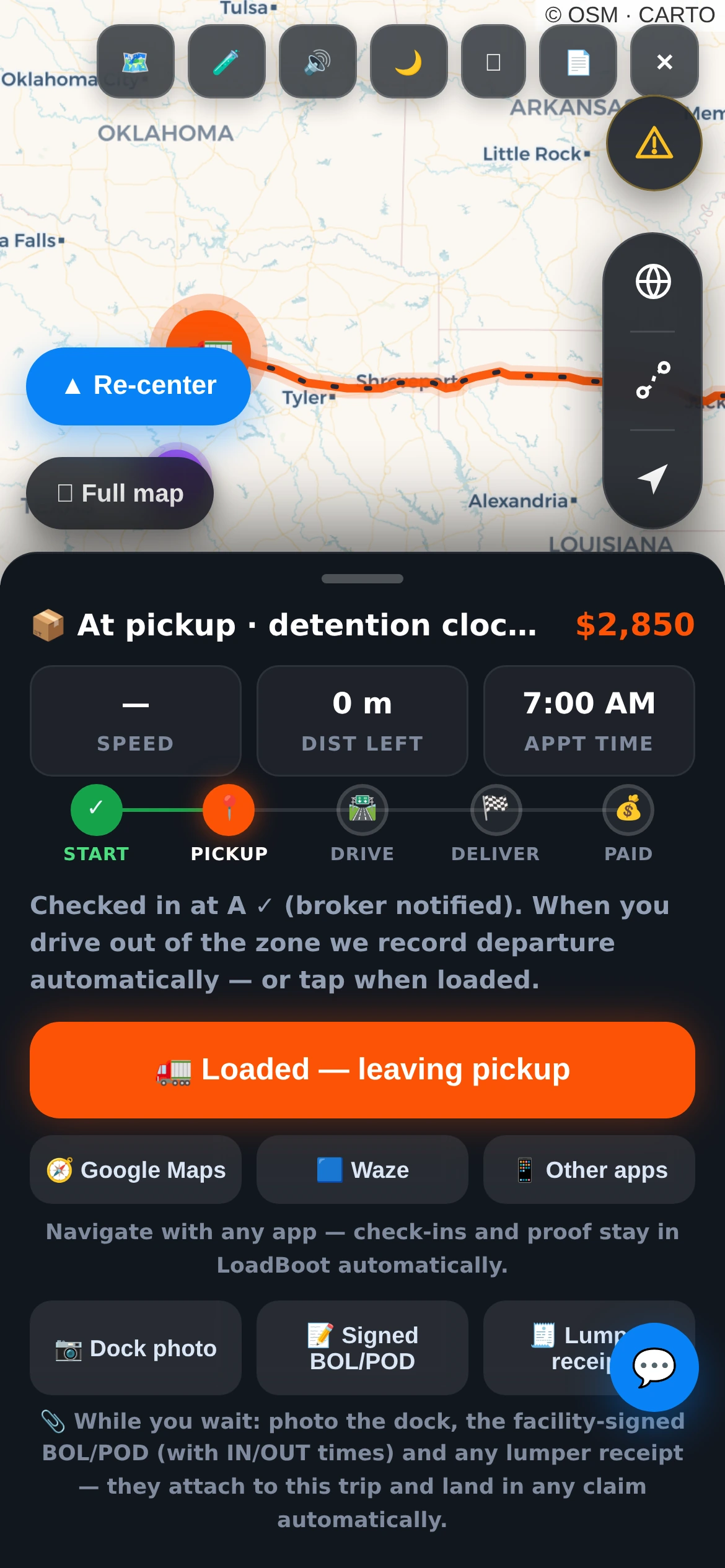
No terminal, no tablet mount, no ELD contract. The LoadBoot app installs on any phone and the trip map opens straight onto the current leg — real road routing on a dark map that doesn’t blind you at night.
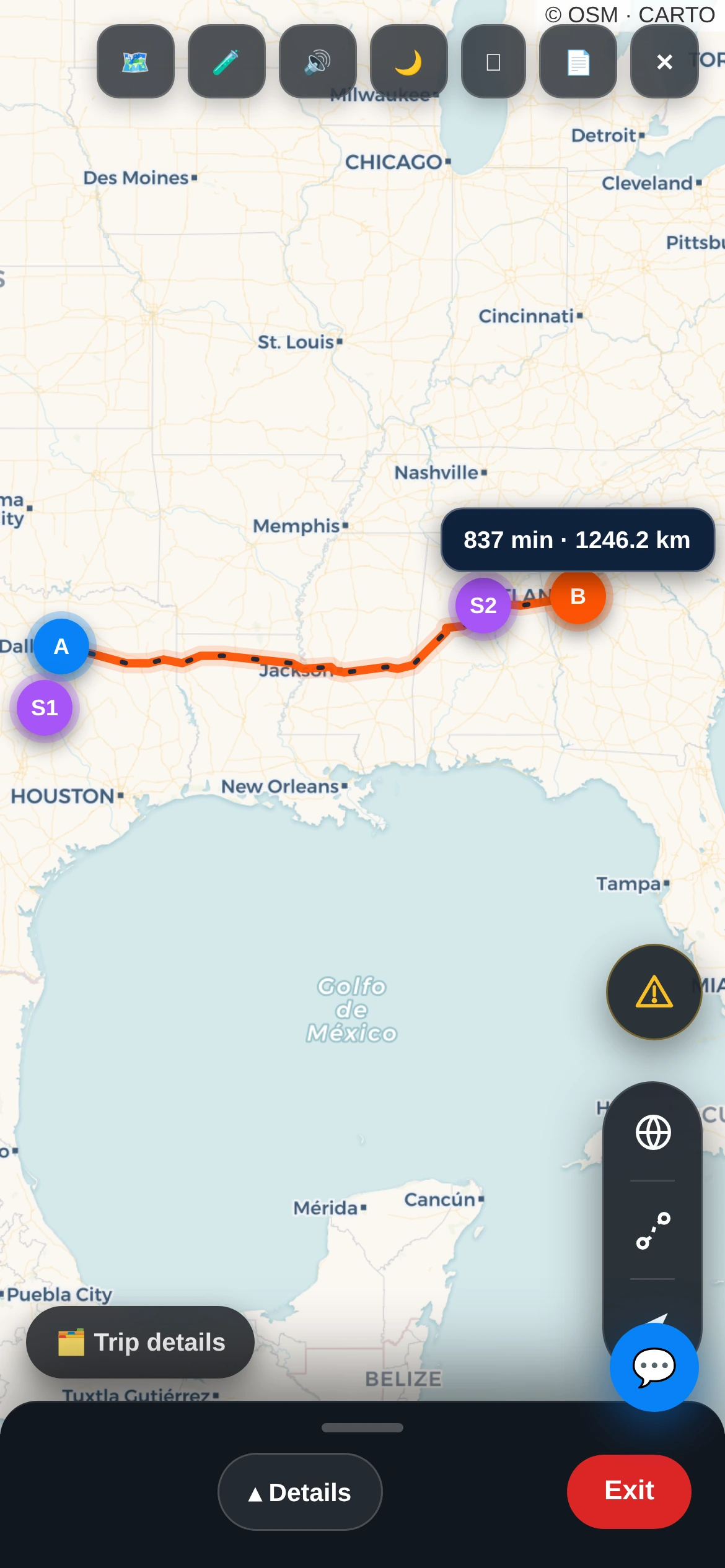
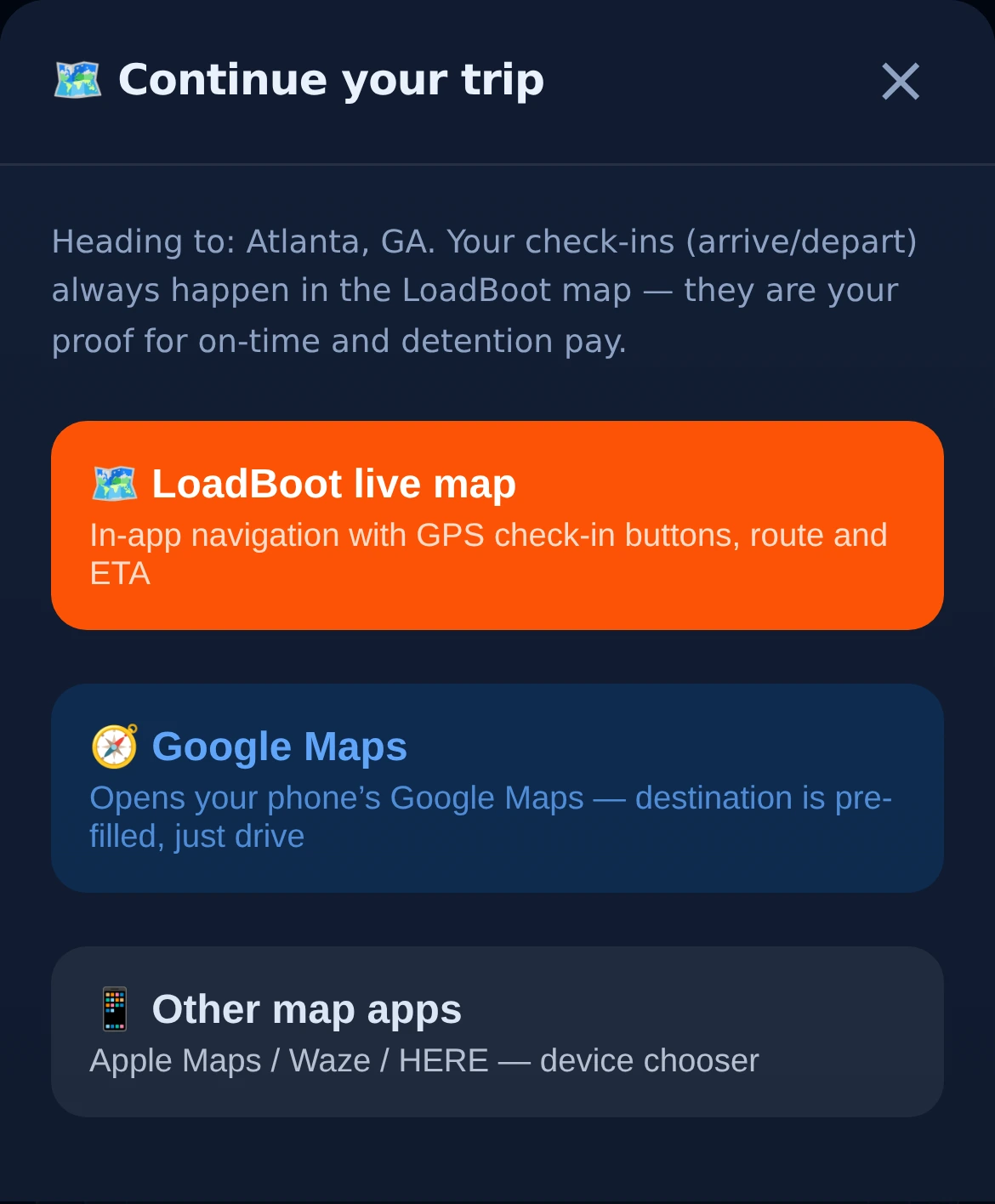
The moment a trip is dispatched, an 800-meter geofence arms at pickup, at every extra stop, and at delivery — from the exact pins the poster set.
Cross in: Arrive. Cross out: Depart — with hysteresis so circling the yard or a GPS wobble never double-stamps. Every stamp is recorded server-side.
From dispatch to delivery, tracking is locked on — it can’t be quietly switched off mid-trip. Positions post about every 25 seconds.
No ping for 30 minutes? The live view flags the feed stale and blackout watchdogs alert dispatch — dead phones don’t become dead trails.
Everything that pays a carrier beyond linehaul depends on proving time and place — and that is exactly what this system records. The detention clock starts from the recorded arrival (2 hours free standard, then $60/hr), layover and TONU claims attach the event log automatically, and your on-time history is built from delivered facts, not memory.
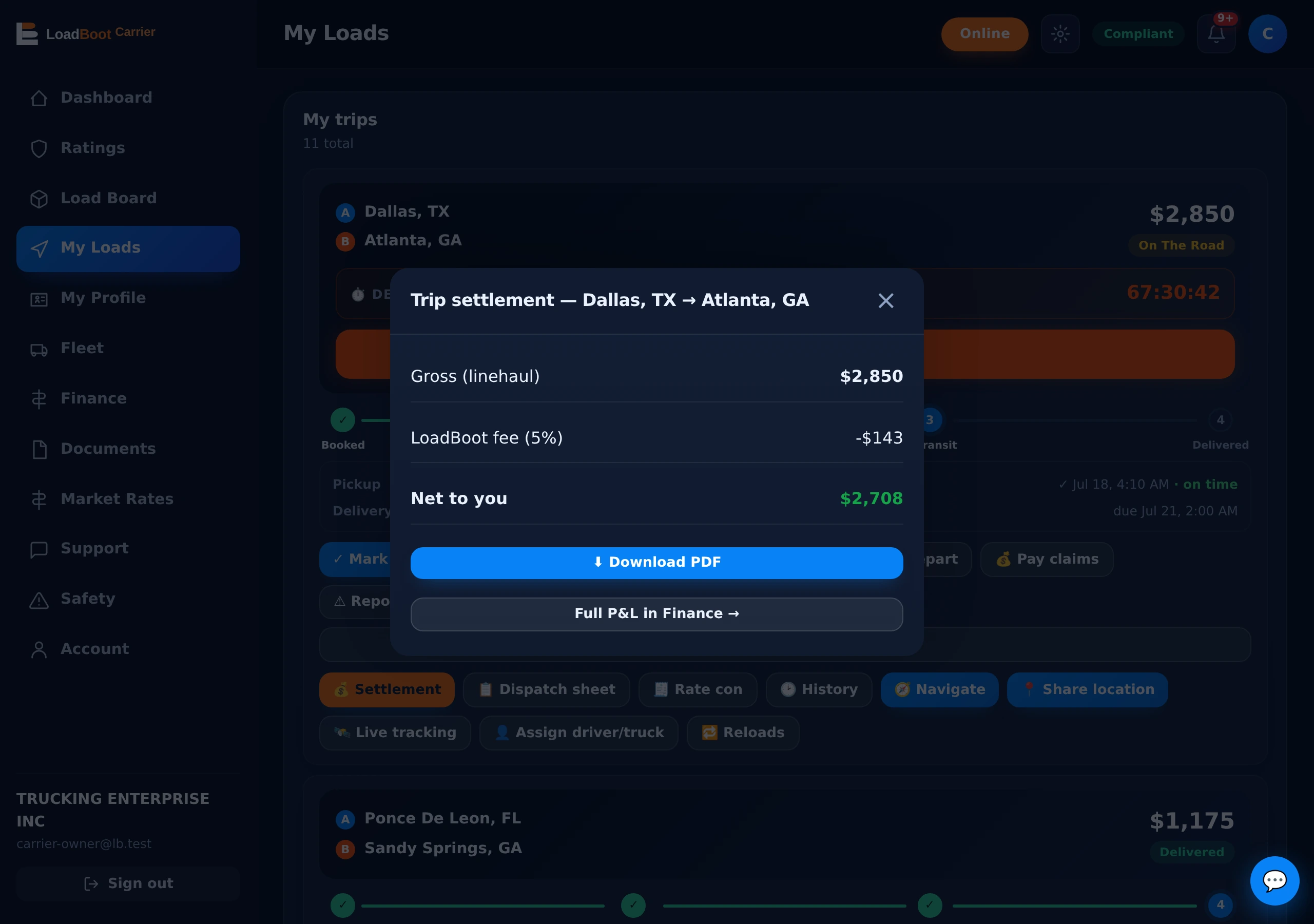
Open the load and you’re looking at the truth: a milestone timeline from posted to delivered, the truck moving on the map with a live ETA, and detention accruing per stop as it happens — the same numbers the carrier sees, so there is nothing to argue about later. Shippers who post directly get exactly the same view.
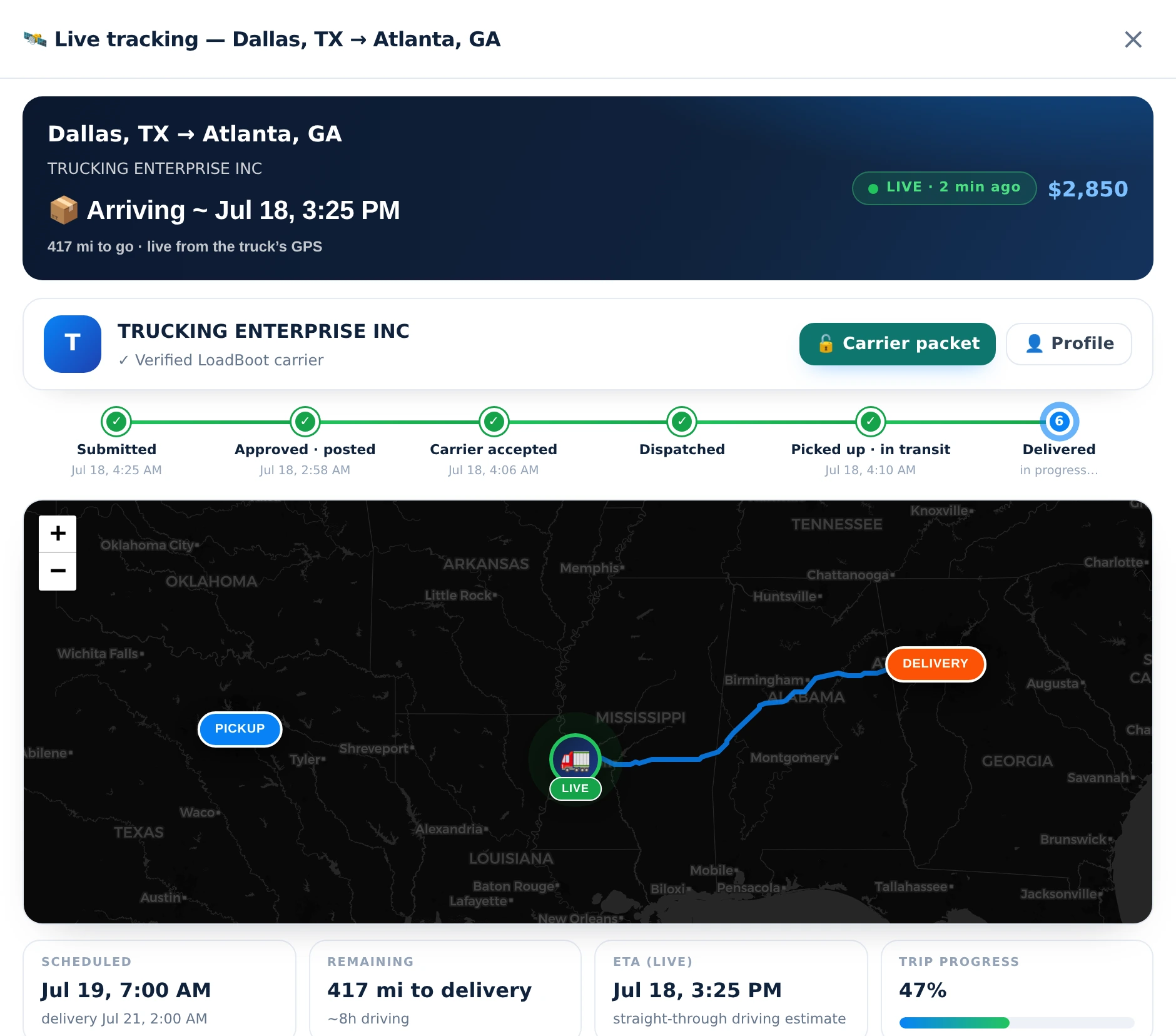
Most tracking tells you where a truck is. LoadBoot’s builds a court-grade file of the whole trip — and every record protects someone.
| Proof recorded | Protects the carrier | Protects the broker / shipper |
|---|---|---|
| Arrive / depart stamps (800 m geofence, server-side) | Detention & layover pay with evidence | Proof of dock performance · no inflated claims |
| Position trail (~every 25s, dispatch → delivery) | On-time history & account health built from facts | Live ETA · zero check calls · customer answers |
| Per-stop records on multi-stop routes | Stop-off pay & per-stop detention proven separately | Every facility’s dwell time, measured |
| POD photos + delivery docs in-app | Triggers the invoice the same day | Instant delivery confirmation for the customer |
| Event log on cancellations | TONU claims backed by “I was there” proof | Defense against false-arrival claims |
| Stale-feed & blackout flags | Honest record when signal dies — trail resumes clean | You’re never lied to by an old dot |
| Emergency & issue reports (timestamped) | Verified emergencies reschedule with no TONU | Real reasons, on record, within 2 hours |
Third-party trackers watch a truck. This tracking lives inside the same system as the booking, the rate card and the invoice — so proof flows straight into money.
Timestamps are recorded server-side from GPS events. Nobody — carrier, broker, or LoadBoot staff — has an edit button on the event log.
Carrier and poster look at the identical map, meters and log. Symmetric information is why disputes on LoadBoot die young.
Tracking exists only between dispatch and delivery. No 24/7 surveillance, no selling location data — off the clock means off the map.
| LoadBoot | Check calls / macro apps | |
|---|---|---|
| Driver effort | ✓ zero taps — geofences stamp themselves | ✗ calls, texts, manual check-ins |
| Detention proof | ✓ server-verified arrive/depart, auto-filed | ✗ “driver says he was there at 9” |
| Hardware needed | ✓ any phone · ELD optional | ELD contract or nothing |
| Privacy off-duty | ✓ tracking ends at delivery, by code | ✗ 24/7 hardware tracking |
| Broker visibility | ✓ live map, ETA, detention meters, event log | a phone number and hope |
| Feed honesty | ✓ stale flag + blackout watchdogs | ✗ last known dot, hours old |
No. Tracking runs only while a trip is active — it locks on at dispatch and shuts off automatically at delivery. Off the clock, nobody is watching. That privacy line is built into the code, not a policy promise.
No. The driver’s phone is the tracker — the trip map runs in the LoadBoot app with GPS positions posted about every 25 seconds. If you already run Samsara or Motive, connect it and tracking flows from your ELD instead.
Yes — one tap hands navigation to Google Maps, Waze or any app the driver prefers, while LoadBoot keeps recording positions and geofence check-ins in the background. Turn-by-turn with voice cues is also built into the trip map itself.
Every stop — pickup, each extra stop, delivery — gets an 800-meter geofence. Rolling inside records Arrive; rolling out records Depart. No driver taps, no forgotten check-ins, and every timestamp is server-side evidence for detention.
The live view flags the feed as stale after 30 minutes without a ping, and blackout watchdogs alert dispatch. The moment the phone reconnects, tracking resumes and back-fills the trail — and the server-verified event log keeps its integrity.
The detention clock runs on recorded arrive/depart timestamps — standard 2 hours free, then $60/hr. Because the clock runs on server-verified GPS events, the claim files itself with evidence attached instead of becoming a phone argument. See the detention policy for the numbers.
A milestone timeline, the live truck marker with ETA on a map, detention accruing per stop in real time, and a server-verified log of every arrive, depart and POD — the exact same numbers the carrier sees, which is why disputes die on this platform.
The tracker is throttled to a position roughly every 25 seconds and holds a screen wake-lock only while the trip map is open. A phone on a dash charger — how drivers actually run — never notices it.
Posters choose: loads can be posted with tracking required, and most are — because tracked loads get covered faster and pay accessorials without friction. For carriers, tracking is what turns detention from a fight into a payout.
Carriers: your next detention claim files itself. Brokers & shippers: your next check call is your last.